
News
Content
It is 6:40 a.m. and a service van is parked outside a locked commercial unit. The electrician has the work order, the parts, and a two-hour window before the tenant arrives. What he does not have is the key, and the facilities manager is forty minutes away. Every trade runs into a version of this: the key that should be waiting on site is missing, the combination has been changed by someone who has since moved to another job, or the box itself has rusted shut after a winter on a gate post.
For contractors, a key lock box is not a spare-key hiding place. It is a shift-access tool that has to survive rain, dust, a drop from the top of a ladder, and six different people using it in one week. Three things decide whether a box actually works on site: the body and shackle material, how quickly the code can be reset between crews, and whether the internal space holds the keys and fobs your jobs really involve. Everything else is decoration.
Buy for rotation and abuse, not for the lowest unit price. A homeowner box protects one spare key for one family, and it is opened perhaps twice a year. A contractor box is handled daily, shared across trades, and frequently hung in a place that was never designed to hold it: a site hoarding, a container latch, a chain-link gate, or a temporary hasp fitted by whoever arrived first.
That difference changes the specification. Turnover matters, because the person holding the code this month may not be the person holding it next month. Exposure matters, because a box on a fence post sees driven rain and road grit, while a box on a porch sees neither. And accountability matters, because when several subcontractors share one box, the code itself becomes part of the site procedure. A box that cannot be recoded in under a minute will keep an old code far longer than anyone intends.
Volume is the last difference. A single homeowner buys one box; an electrical contractor, a cleaning company, or a rental fleet may buy ten to thirty at a time and expects every unit to behave identically, from dial resistance to paint finish. Consistency across a batch is a manufacturing issue, not a retail one.
Shackle-mounted boxes cover the widest range of contractor situations, because they hang on whatever is already there. Wall-mounted boxes suit fixed locations where the same key cabinet is needed for months. Slim, low-profile boxes exist for one reason: a door frame or a narrow reveal gap that will not accept a full-size body. Choose the shape from the mounting point you actually have, not from the shape you prefer.
| Style | Best for | Typical mounting | Most common failure |
|---|---|---|---|
| Shackle-mounted body | Trades moving between sites, temporary gates, containers, scaffolding access | Hangs on a hasp, chain, or gate latch | Shackle diameter does not match the hasp, so the box hangs loose and can be twisted |
| Wall-mounted body | Site offices, plant rooms, rental units, long-running maintenance contracts | Bolted through the back plate into masonry or a stud | Screws instead of through-bolts; the plate pulls straight out under load |
| Slim, low-profile body | Door frames, narrow reveals, cupboards where space is tight | Over-door hook or a small bracket | Capacity is overestimated; the hook can be lifted away if it is not secured |
A practical rule: if the box has to move with the crew, choose a shackle-mounted unit; if it stays, bolt it through with security fasteners and treat the fasteners as part of the purchase.
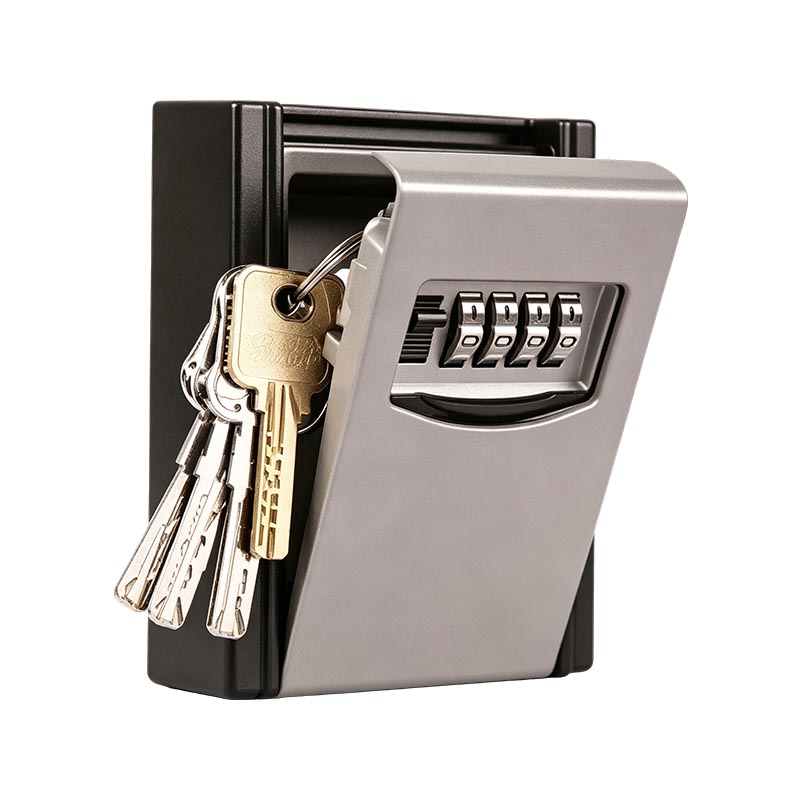
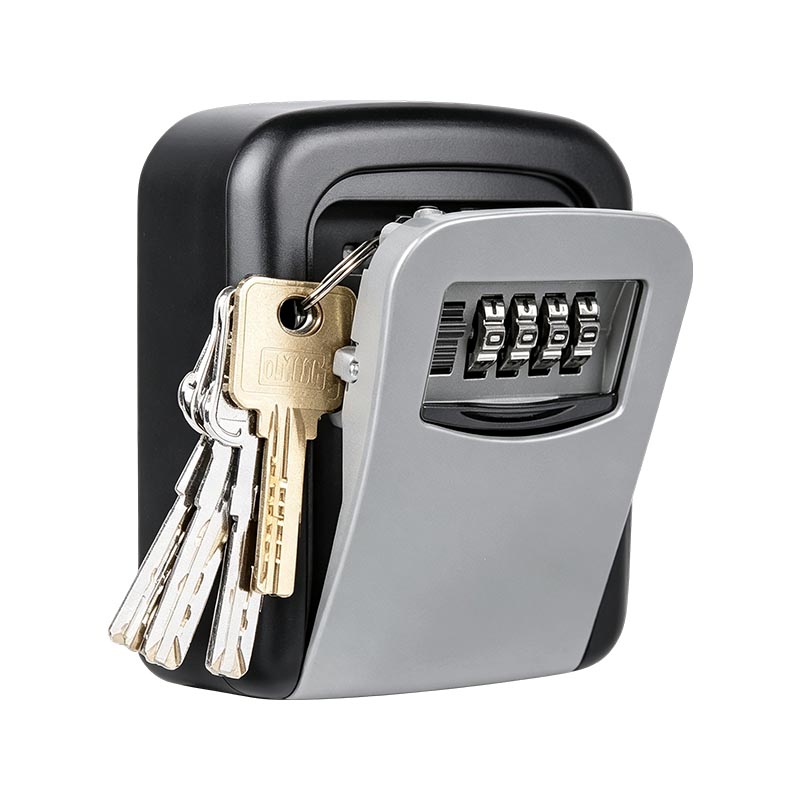 Arc-Shaped Aluminum Alloy Key Lock BoxAluminum alloy lock box offering a lighter, affordable option for fixed wall or hanging installation, with 4-digit combination and multiple-key capacity.View Product →
Cast zinc alloy is the usual choice for combination lock boxes because it holds fine dial detail and resists corrosion reasonably well. Aluminium bodies are lighter and often cheaper, but the threads and hinge points wear faster when a box is used heavily. Stainless steel bodies cost the most and are the sensible answer for coastal sites, food processing areas, and anywhere salt is in the air.
Look at the shackle first, because it takes the abrasion. Zinc-plated steel is adequate indoors and under a canopy; once the plating is scratched on a site gate, rust starts at that scratch. Stainless steel shackles cost more and last considerably longer outdoors. A dust shutter over the dials, a drain path so water cannot pool behind the wheels, and a rubber or silicone cover are small details that decide whether the box still opens in February.
Ask a supplier for salt spray hours rather than the word waterproof. A factory that runs its own salt spray, tensile, and torque testing can give a number; a trading office usually cannot. Those three tests matter in different ways: salt spray predicts outdoor life, tensile testing covers the shackle under pull, and torque testing covers whether the dial mechanism survives years of impatient turning with cold hands.
Three dials give a thousand combinations; four dials give ten thousand. For a box shared across a site, four dials is the safer default, not because a thousand is easy to guess, but because a single careless choice reduces the practical difference. A four-dial resettable mechanism is the specification most contractors settle on.
The reset routine is where discipline beats hardware. Most resettable boxes are recoded by opening the box, moving an internal lever or button, setting the new number, and returning the lever. Two habits prevent almost every problem: change the code at each phase handover or crew change, and write the current code in the site log rather than sending it through a group chat that outlives the job. Avoid codes based on a van registration, a postcode, or a year, since those are the first combinations anyone tries.
Also test the new code once with the lid open before closing the box. A reset that was one wheel off is the single most common call-out on a locked site.
Internal dimensions matter far more than external ones. A typical commercial task needs six to twelve keys plus two to four fobs or access cards, and a fob is thicker than a key, so the depth of the internal hooks decides whether the lid closes properly. A slim box may hold three to five keys comfortably and nothing more; forcing ten keys into it jams the door and eventually breaks the hinge.
Weight is the other consideration. A heavy bunch of keys hanging from a lid puts continuous load on the hook and the closure. If the box will hold more than about eight keys, choose a deeper body and check that the internal hooks are metal rather than moulded plastic.
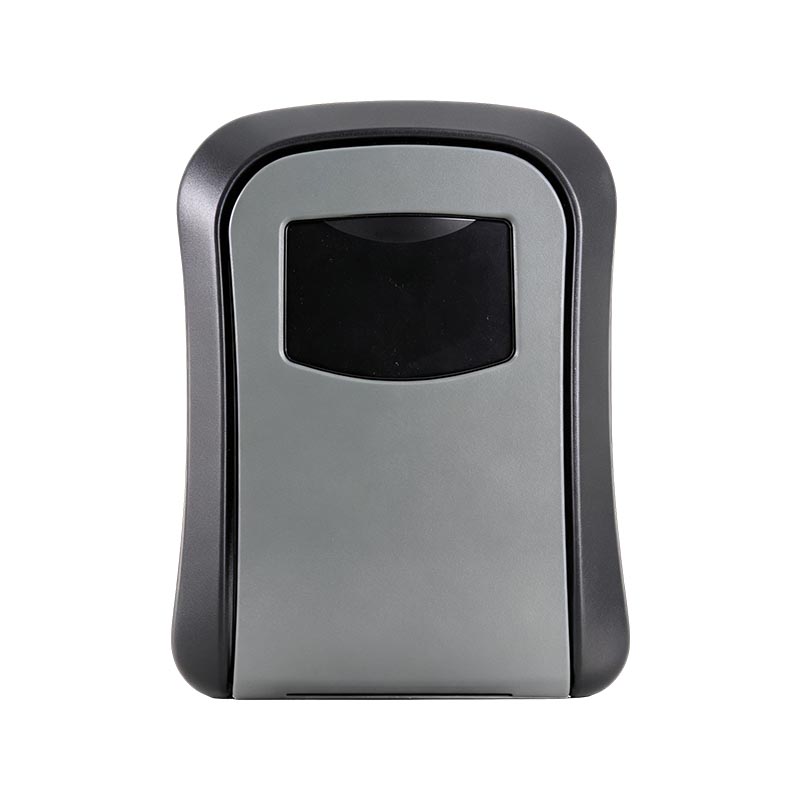 Slim Waist Aluminum Alloy Key Lock BoxSlim waist aluminum alloy lock box with waterproof seal, suitable for multiple keys, and includes 4-digit combination for shared management.View Product →
Run through these points before placing an order, and ask the supplier to confirm each one in writing.
Most failures are procedural rather than mechanical, and they repeat across sites.
The fix is rarely a different product. It is a one-page site rule: who holds the code, when it changes, and what happens when a key is lost.
When a contractor supply business, tool brand, or rental fleet buys in volume, the questions change. Will the dials feel the same on unit one and unit four hundred? Is the paint or coating consistent? Can the supplier document its testing, provide spare parts, and adapt a body shape or logo for a private label program?
That is where a manufacturing background helps. Zhejiang Rongtao Hardware Products Co., Ltd. operates as a lock source factory with more than 30 years of experience, supported by Yiwu Shengping Lock Factory and its nearly 30 years of padlock production. An internal lock testing laboratory runs salt spray, tensile, and torque tests alongside general performance checks, and the plant holds ISO, TUV, SGS, and BSCI certification. The site covers 18,000 square metres with around 100 staff, and products ship to more than 20 countries across Europe, South America, Asia, and Africa, with customized designs supported for overseas buyers who need specific colours, codes, or packaging.
Ordering in volume is a specification conversation, not a catalogue click. If you need a specific shackle size, dial colour, or a private-label body, browse the key lock box range first and then contact the factory with your target quantity and packing requirements.
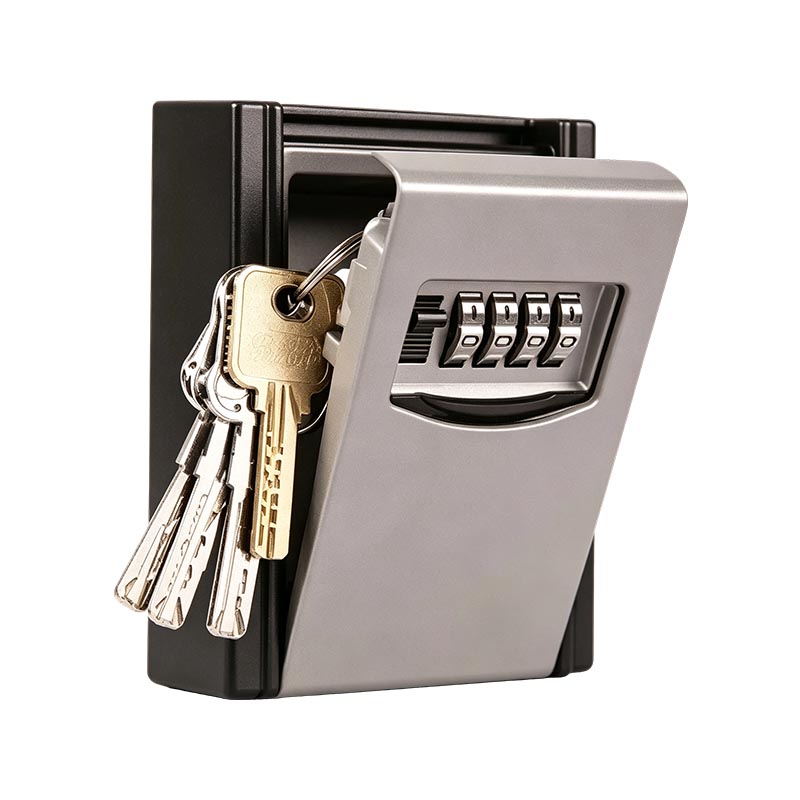 Square Aluminum Alloy Key Lock BoxSquare die-cast aluminum lock box for controlled key access, ideal for low to medium value items, with 4-digit combination and waterproof seal.View Product →
They are a controlled-convenience tool, not a vault. For site-access keys, plant room keys, and low to medium value equipment, a well-mounted box combined with a code rotation rule is entirely practical. Do not use one to store master keys for high-value buildings.
At every crew change, phase handover, and after any unexplained access. On a long fixed site, once a month is a reasonable baseline, and always when someone leaves the project.
A zinc alloy body with a dust shutter and a stainless steel shackle handles normal rain and grit. In hard frost, ice can seize the dials, so hang the box in a sheltered position if the site runs through winter.
Three dials give a thousand combinations and four give ten thousand. Both can work, but four dials leaves more margin once several people and several projects share the same box.
Check internal dimensions, not the external size. Slim bodies generally take three to five flat keys, while deeper bodies hold eight to twelve keys with room for two to four fobs.
Choose the mounting point first, the material second, and the code routine third. A four-dial, resettable box with a stainless steel shackle, a drain path, and a written rotation rule will keep a site moving through winter; the cheapest option on the shelf usually will not survive the first frost.
Next Article:
Hot Recommended Products
Through continuous innovation, we build a high‑end R&D team, form a diversified cluster of lock and hardware products, and accelerate the high‑quality industrial development of safety hardware locks.
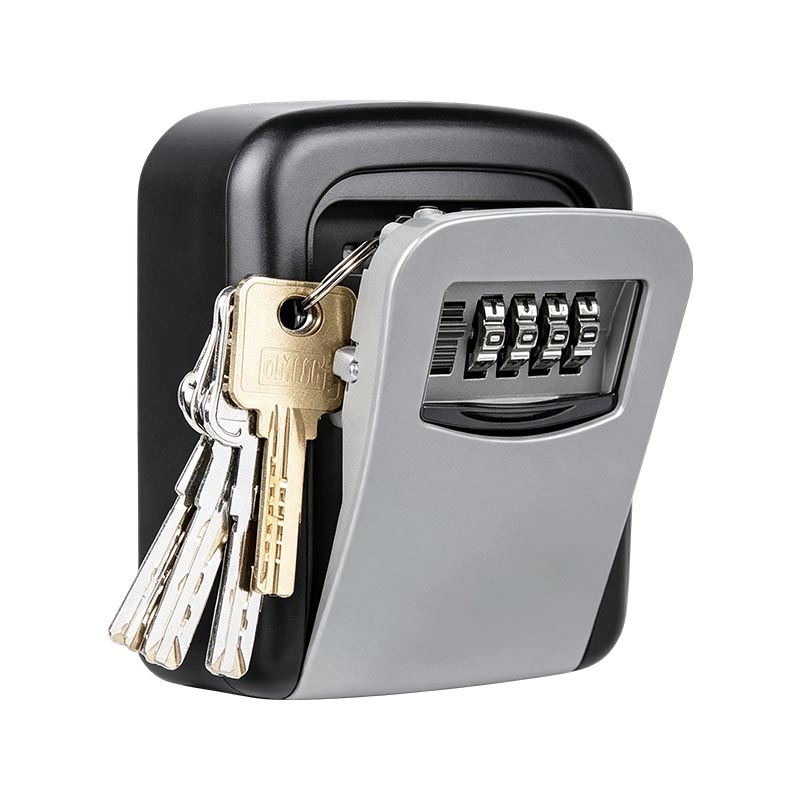

With thirty years of experience manufacturing EN 12320 certified padlocks, we maintain strict control over raw materials and quality.
Contact Information
+86-579-85665313
+86-579-85665685
market@chinajiuzhou.com
Tony Xu
E-mail:sales2@chinajiuzhou.com
Add
No. 11 Wuhan Road, Shangxi Town, Yiwu City, Zhejiang Province, China 322006
Quick Links
[Mobile]
Keep In Touch

 English
 Français
 Español
 Deutsch
 عربى
عربى
 italiano