
News
Content
A gate padlock on a harbour wall often fails within a single season. Six months in, the shackle stiffens; by the following spring the key turns halfway and the lock has to be cut off. The cause is rarely weak construction — it is the wrong material specification for a chloride-rich site.
The short answer, before the detail: within roughly 200 metres of open salt water, specify a stainless steel disc padlock with a 304 or 316 body and a shrouded shackle. Between 200 metres and about two kilometres, solid brass or 304 stainless will usually hold up if the lock is rinsed occasionally. Painted iron, zinc die-cast bodies and most open three-wheel combination locks are a poor bet in either zone, however good the catalogue photograph looks.
The rest of this guide explains why, what to write on a purchase order, and how to tell a genuinely coastal-rated lock from one that merely claims to be.
Salt does not need to be visible to cause damage. Sea air carries chloride particles that settle on metal, absorb moisture once relative humidity passes roughly 75 percent — the deliquescence point of sodium chloride — and form a thin, conductive electrolyte film across the surface. In a maritime climate that film never fully dries, so the corrosion reaction runs overnight and through still, damp weather.
On a plated shackle the first sign is a rust bloom at the cut end or inside the keyway, where plating is thinnest. Pitting follows on the body, corrosion product swells inside the shackle bore, and the lock seizes. In a splash zone this sequence commonly takes one to two seasons. Brass bodies may show pink or red staining as zinc leaches out — dezincification — long before anything actually jams.
| Exposure zone | What the lock meets | Specification that holds up |
|---|---|---|
| Splash zone, under 200 m | Wind-driven spray, salt film most days, full wetting in storms | 316 or 304 stainless body, shrouded stainless shackle, sealed disc cylinder, capped keyway |
| Coastal town, 200 m to 2 km | Humid air, salt haze, occasional storm spray | 304 stainless or solid brass, plated shackle, annual freshwater rinse |
| Estuary and brackish water | Salt plus silt and abrasion | Stainless with a drain hole, dry-film lubricant rather than grease |
| Inland humid, no salt | Condensation and rain only | IP65 iron or brass with a protective cover |
The pattern is regular enough to plan around, which is why test data beats adjectives on a datasheet.
The molybdenum addition gives this grade markedly better resistance to chloride pitting than 304, and it is the reference material for jetty gates, marina stores and anything washed by spray. Expect to pay 1.5 to 2 times the 304 price, and check that the shackle is stainless too — a hardened steel shackle on a stainless body still rusts at the cut end.
Without molybdenum, 304 can develop tea-staining and shallow pitting in a splash zone, but it remains far more durable than plated steel and is the sensible default for most coastal properties. Look for passivated surfaces and a disc-style cylinder with a narrow keyway entry, which is easier to flush clean.
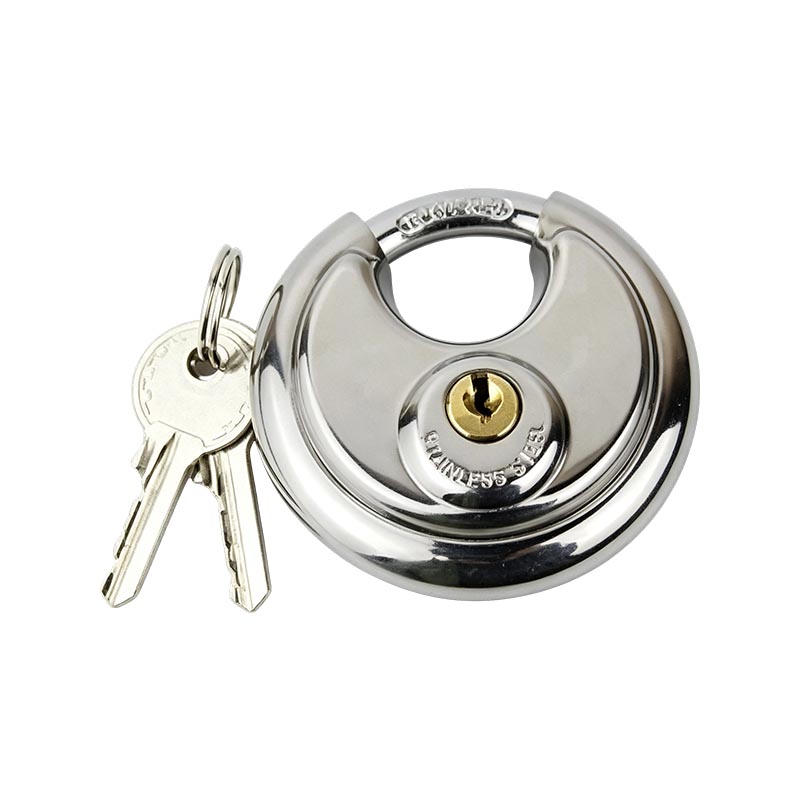
Our own 304 disc body is the specification we supply most often for harbour and beachfront use.
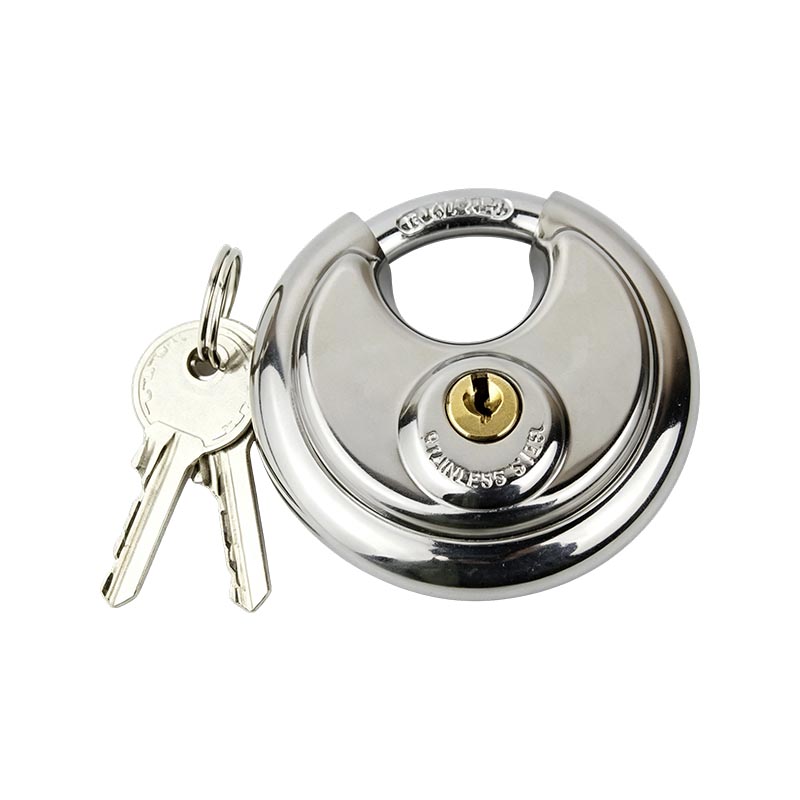 304 Stainless Steel Disc Padlock for Coastal UseKeyed disc padlock with a 304 stainless steel body, brass cylinder, hidden shackle and 60–90 mm sizes for sheltered outdoor security.View Product →
Brass machines well, does not gall, and keeps a smooth shackle action for years — under a porch, in a covered stairwell, or on a locker inland of the promenade. In constant spray, chloride attacks the zinc phase first, so a brass body can discolour and weaken even while it still opens. If you want the reasoning in more depth, this comparison of how brass behaves compared with other padlock materials covers the alloy trade-offs.
Zinc protects by sacrificing itself, which produces white rust and eventually a chalky, porous body. A covered iron lock rated IP65 is a sound choice for a humid inland shed, but it is not a coastal lock, and no amount of paint changes that.
Two locks in the same grade of stainless can differ by years of service, and the difference is in the details. A shackle of 8 mm is adequate for garden gates; 10 mm is more appropriate for container doors and marina stores. Hardened boron steel at 40 to 50 HRC with 25 to 30 microns of chrome or nickel resists cutting well, but every scratch exposes raw steel. Stainless shackles never rust but cut more easily — a trade-off worth stating openly to end users.
A shrouded shackle does two jobs on the coast: it blocks a saw from the shackle legs, and it shields the keyway from direct spray. A disc cylinder adds picking and drilling resistance, and its narrow entry is simple to rinse. Water management matters as much as metallurgy — a small drain hole at the base of the body lets trapped water escape, while a tight, unvented foam cover simply holds a wet film against the metal for weeks.
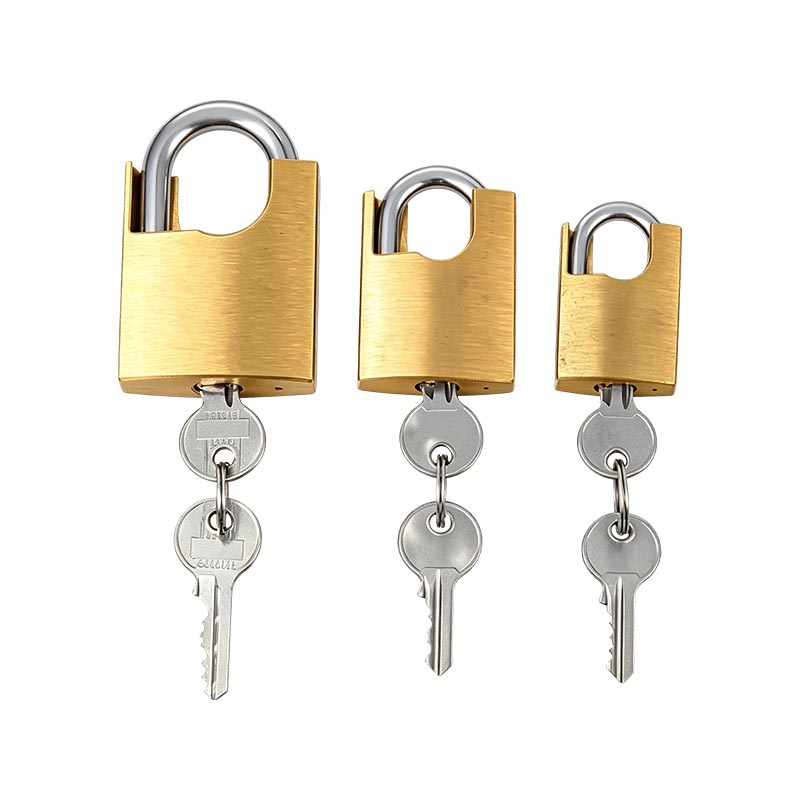 Brass Shrouded Shackle Padlock for Coastal SecurityKeyed brass padlock with a half-covered hardened shackle and double locking bolts, offering sawing and prying resistance in sheltered coastal settings.View Product →
Keyless access is genuinely useful on a shared beach gate, a marina locker or a holiday let key box, where handing out keys is impractical. The catch is the mechanism: dials run on small clearances, and salt crystals bridging a 0.1 mm gap will lock a wheel solid within a season. A four-dial stainless disc combination lock with tight seams and a dry-film lubricant fares far better than an open three-dial unit, and it should be flushed with fresh water whenever it starts to feel gritty.
Keyed locks avoid that problem but introduce key control. For property managers, keyed-alike sets and a master key chart are usually the deciding factor, and a keyway shutter keeps spray and grit out of the pin chamber.
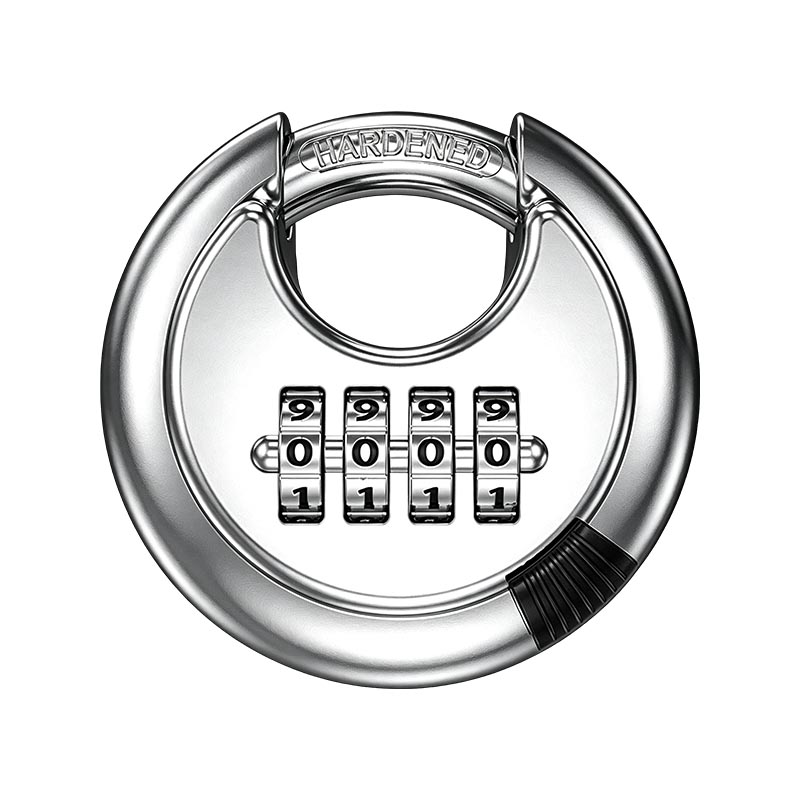 Stainless Steel Disc Combination PadlockKeyless four-digit disc combination padlock in 201 or 304 stainless steel with hardened shackle, suited to shared gates, lockers and humid outdoor areas.View Product →
Zhejiang Rongtao Hardware Products Co., Ltd. runs an in-house lock testing laboratory covering salt spray, tensile and torque testing, backed by ISO, TUV, SGS and BSCI certification and a 18,000 ㎡ facility with 100 staff. Because the associated Yiwu Shengping Lock Factory brings close to 30 years of padlock production, material grades and plating thicknesses are controlled at source rather than bought in blind — the detail that separates a coastal lock from a coastal claim. Custom designs, keying charts and export packing for 20+ markets are handled from the same site.
Send your exposure zone, quantity and keying requirements through the contact page and the team can match a body material and shackle specification to the site.
A 304 stainless disc lock rinsed quarterly typically gives five to eight years within 200 m of the sea; a painted iron lock in the same spot may give one or two seasons.
Yes for direct spray, jetty decks and anything that stays wet. For a covered gate 500 m inland, 304 is usually the better value.
Under shelter, yes — brass keeps a smooth action for years. In constant spray, dezincification will dull and weaken the body.
Salt crystals bridge the small clearances between dials. Flushing with fresh water and a dry-film lubricant prevents most seizures.
Match the material to the distance from the water, insist on a salt spray figure with a report behind it, and treat maintenance as part of the specification rather than an afterthought. That combination is what keeps a coastal padlock opening smoothly in its fifth winter, not its first.
Next Article:
Hot Recommended Products
Through continuous innovation, we build a high‑end R&D team, form a diversified cluster of lock and hardware products, and accelerate the high‑quality industrial development of safety hardware locks.
News Center
News & Information
Real time dynamics, one hand control. Here, we gather enterprise information, industry hotspots, and activity dynamics to help you quickly understand our development pace and cutting-edge insights.

With thirty years of experience manufacturing EN 12320 certified padlocks, we maintain strict control over raw materials and quality.
Contact Information
+86-579-85665313
+86-579-85665685
market@chinajiuzhou.com
Tony Xu
E-mail:sales2@chinajiuzhou.com
Add
No. 11 Wuhan Road, Shangxi Town, Yiwu City, Zhejiang Province, China 322006
Quick Links
[Mobile]
Keep In Touch

 English
 Français
 Español
 Deutsch
 عربى
 italiano