
News
Content
Picture a carton of 5,000 polished stainless steel disc padlocks leaving the factory perfectly clean, spending five weeks in a container, and arriving at a warehouse near the coast with brown speckles around the keyway and under the shackle. Nothing went wrong on the production line. The grade simply could not survive the journey.
That is the real difference between 201 and 304 in a padlock, and it decides a lot of purchase orders. 304 (EN 1.4301, roughly 18–20% chromium and 8–10.5% nickel) keeps its passive film intact in humid, salty and outdoor conditions and is the safer choice for anything that lives outside. 201 (16–18% chromium, 3.5–5.5% nickel, balanced with manganese) costs less, hardens faster, and performs well when the lock stays dry. The grade is not a quality badge; it is a match between material and environment.
What follows is how that match is actually made: chemistry, corrosion behaviour in real sites, the strength question nobody asks, cost maths, and the checks that catch a mislabelled shipment before you pay.
If you only need the short version, use these three rules and skip to the spec table.
| Attribute | 201 stainless steel | 304 stainless steel |
|---|---|---|
| Nickel content | 3.5–5.5% | 8–10.5% |
| Chromium content | 16–18% | 18–20% |
| Manganese content | 5.5–7.5% | 2% max |
| Carbon (max) | Around 0.15% | 0.08% |
| Annealed strength | Higher yield, harder, less ductile | Lower yield, tougher, better fatigue life |
| Neutral salt spray to red rust | Often 24–72 hours | Commonly 96–200 hours |
| Relative raw material cost | Typically 25–40% lower per tonne | Higher, nickel-driven |
| Typical fit | Indoor, dry, cost-sensitive ranges | Outdoor, coastal, humid, washdown |
Both are austenitic stainless steels, and both protect themselves with a chromium oxide film a few nanometres thick that re-forms after a scratch. The difference is what holds the austenitic structure together.
Nickel is the expensive ingredient, so the substitution is where the price gap comes from. Two side effects matter on a padlock. First, 201 work-hardens very quickly, which makes it hard and abrasion resistant after pressing but also less forgiving — deep-drawn bodies and stamped edges are more prone to micro-cracks than 304. Second, with less chromium in the mix, the passive film rebuilds more slowly after scratching or machining, so a 201 body that has been laser engraved or roughly ground has a weaker spot exactly where water collects.
Rust almost never starts on a flat polished face. It starts in crevices: the keyway, the shackle holes, stamped edges, laser engraving, and the gap between body and dial. Those are places where chlorides sit, oxygen is low and the passive film cannot repair itself. That is why two locks made from the same coil can age very differently depending on design and finish.
Below roughly 60% relative humidity, with no salt and no chemical splash, 201 padlocks hold up for years. Gym lockers, office cabinets, indoor storage cages and retail display locks are classic 201 territory, and paying for 304 there buys little beyond peace of mind. If the lock is indoors and the finish is properly passivated, 201 is a rational purchase.
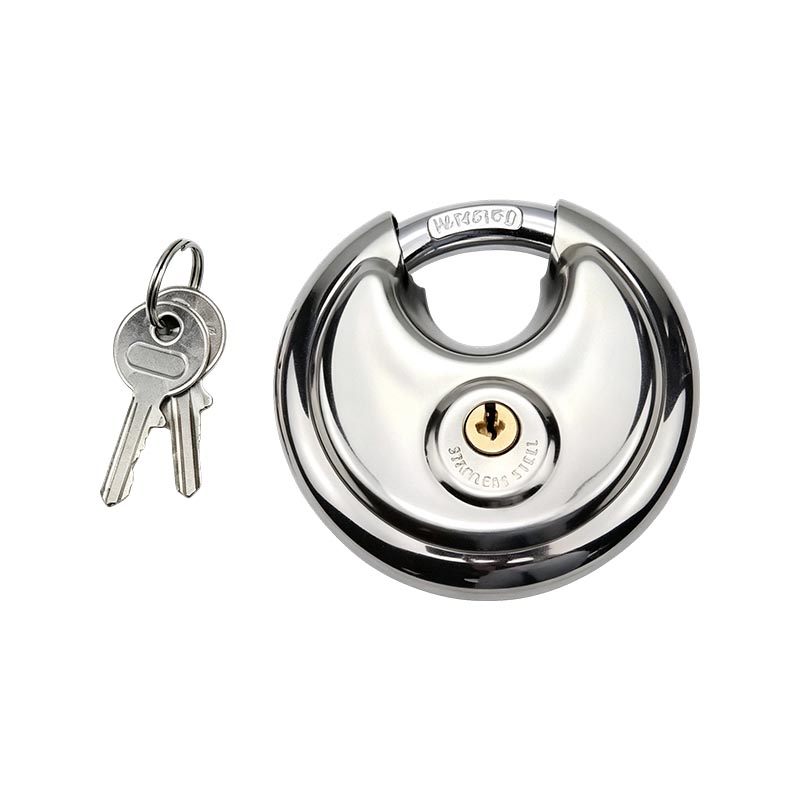
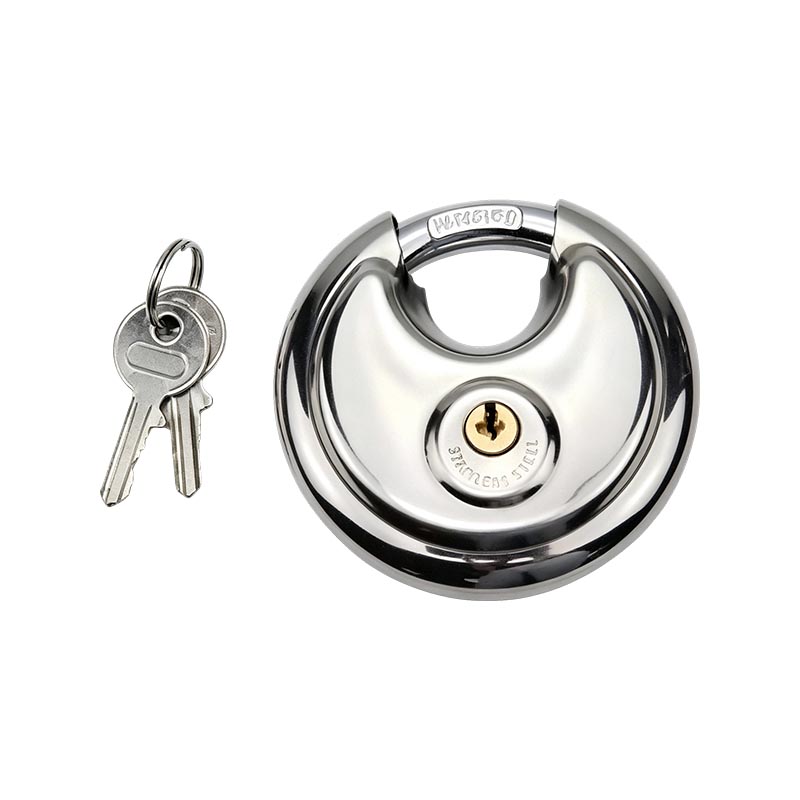 201 Stainless Steel Disc PadlockA keyed 201 stainless steel disc padlock with brass cylinder and 60–90 mm options, a practical choice for indoor and sheltered basic anti-theft locking.View Product →
In neutral salt spray testing, 304 padlock bodies commonly run 96–200 hours before red rust appears, while 201 often shows pitting somewhere between 24 and 72 hours, depending on surface finish and passivation. Coastal air, de-icing salt, fertilizer stores, swimming pool plant rooms, marine docks and cold rooms with heavy condensation are all 304 duty. So is any market where the lock is expected to look new after a year outdoors — appearance is often the complaint that reaches the buyer first.
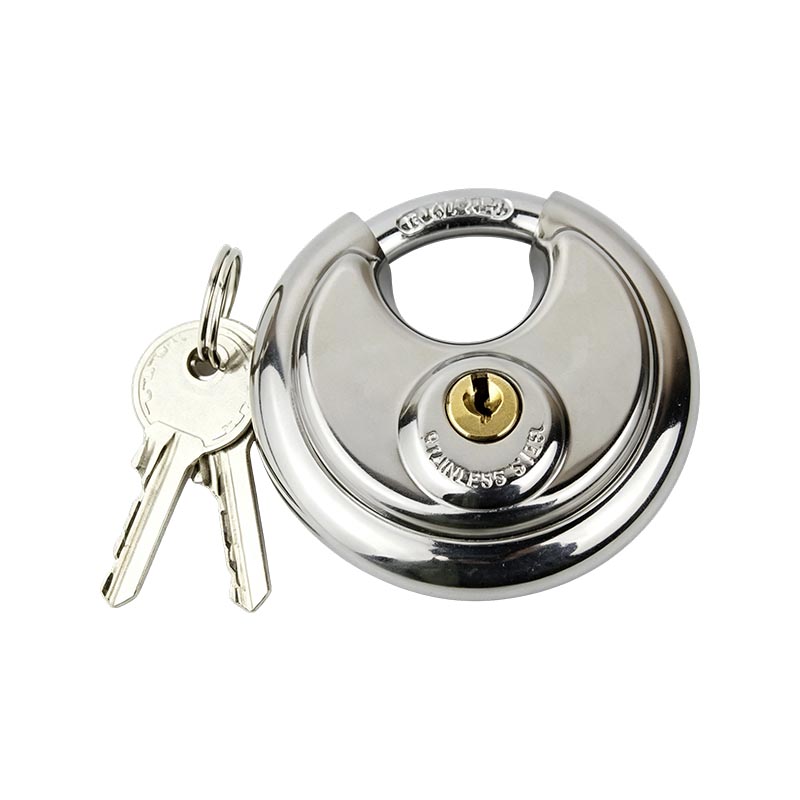 304 Stainless Steel Disc PadlockA polished 304 stainless steel disc padlock with hidden shackle and brass cylinder, suited to coastal and corrosive outdoor settings where appearance matters.View Product →
One detail worth building into the order: sea freight itself is a corrosion test. A container crossing the equator cycles through high humidity and condensation for weeks. For long routes, specify VCI bags or desiccant rather than relying on the grade alone, and ask for the locks to be packed dry with no residual polishing compound in the crevices.
Here is the part that surprises buyers. In the annealed condition, 201 often shows a higher yield and tensile strength than 304 — it is genuinely harder. Harder, though, is not tougher. 201 has less ductility, so it cracks rather than deforms under impact or aggressive forming, and its fatigue behaviour under repeated load is weaker. For a thin drawn body that gets dropped on concrete, that difference shows up as splits at the rim.
But the grade does not set the security of the padlock. Attack resistance comes from the shackle and the locking mechanism. A 201 body with a properly hardened shackle and a good disc cylinder will outlast a 304 body with a soft shackle every time. When you write the enquiry, ask separately for:
Round-body disc padlocks are where grade choice is most visible, because the body is thin, exposed and usually polished. A scratched 201 disc body develops rust lines along the scratch within weeks outdoors, and on a polished surface that reads as a defect even when the lock still works. Combination disc locks add a further wrinkle: the dial pack creates a ring of narrow gaps where moisture and dust collect, and those gaps are hard to dry out after rain.
For outdoor combination models, specify a 304 body and dial cover, and ask how the dial is sealed. For indoor locker and cabinet ranges, a 201 body with a well-finished dial is fine and keeps the price competitive.
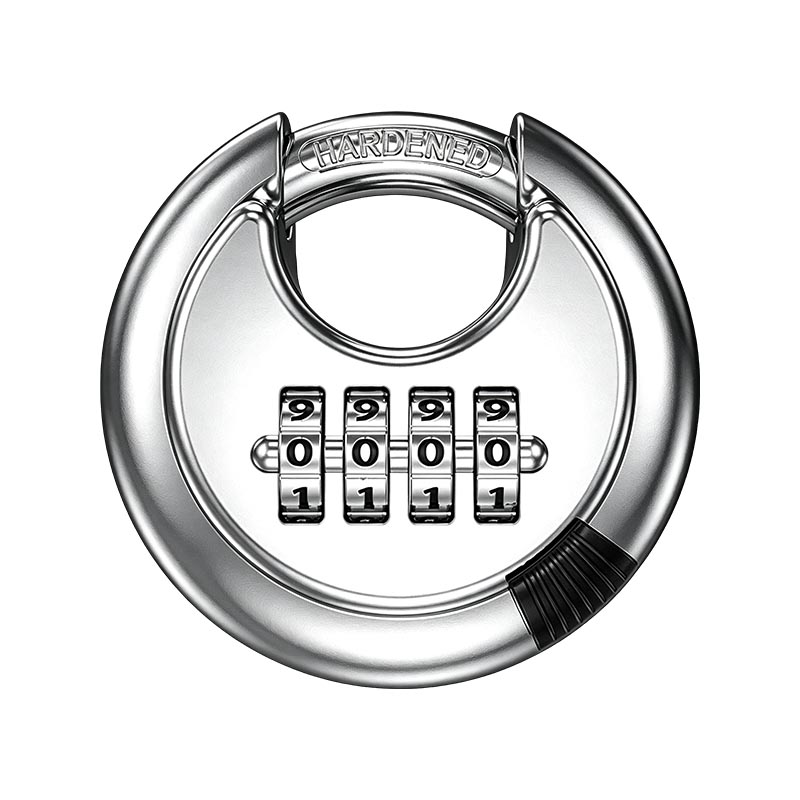
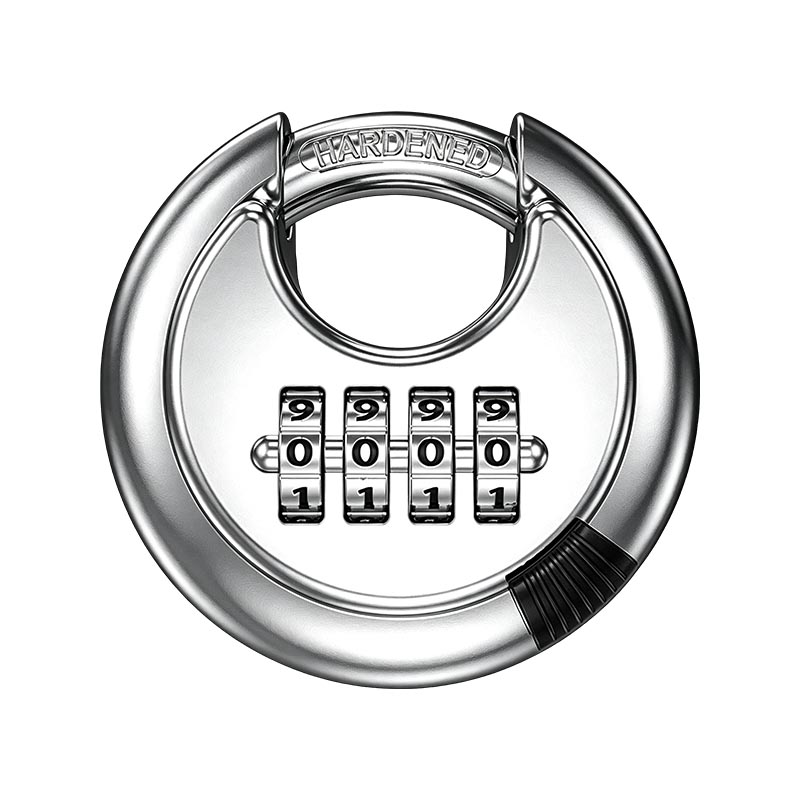 201/304 Stainless Steel Disc Combination PadlockA keyless four-digit disc combination padlock available in 201 or 304 stainless steel, with hardened steel shackle for lockers, cabinets, and outdoor use.View Product →
If you are building a private-label range across several body styles, it helps to see how OEM and ODM programmes are normally structured before you fix the grade split — our padlock OEM and ODM sourcing guide covers sampling, tooling and approval steps.
201 strip commonly runs 25–40% below 304 per tonne. On a finished padlock, though, the FOB gap is usually closer to 8–15%, because the shackle, cylinder, springs, plating, assembly and packaging cost exactly the same in both versions. Buyers who expect a 30% cheaper lock are usually comparing two different specifications without noticing.
Then there is the cost that never appears on the quotation. One rust complaint on a 5,000-piece order means sorting, replacement production, air freight, credit notes and a conversation with your customer about whether the material was really as described. A simple rule works well: if replacing one lock in the field costs more than three or four times the per-unit saving, specify 304 and stop calculating.
Vague wording is how grade disputes start. "Stainless steel" on a purchase order means nothing; the following clauses close the gap.
Verifying the grade after the fact is straightforward if you plan for it. Check chromium, nickel and manganese on the mill certificate — 201 is unmistakeable with manganese at 5.5–7.5% and nickel under 5.5%. A handheld XRF analyser sorts Cr/Mn/Ni ratios quickly, though it cannot read carbon. A magnet proves nothing: both grades can turn magnetic after cold working, and 201 is not reliably distinguishable that way. If a dispute escalates, laboratory chemistry or an independent salt spray report settles it in days.
No. It is a budget grade with a narrower window of good performance. Indoor, dry, cost-sensitive ranges are exactly what it was developed for. The problem is not the material, it is putting it somewhere it cannot cope.
201 is harder in the annealed state and shows higher yield strength; 304 is tougher and resists fatigue and impact better. For security, the shackle hardness and the locking mechanism matter far more than the body grade.
It happens, usually through loose wording rather than deliberate fraud. A mill certificate with heat number, plus XRF spot checks on incoming batches, is enough to protect an order. Put the grade and standard in writing.
Yes, in chloride-rich or long-standing wet crevices, or if free iron was embedded during polishing. Passivation after finishing is what keeps the surface passive, and it is worth specifying explicitly.
On finished padlocks, expect roughly 8–15% at FOB for the same model, since most components are shared. Anything beyond that usually signals a different shackle, cylinder or finish as well.
Decide from the environment, not from the price list. Dry and indoor: 201, with a hardened shackle and a clean finish. Wet, salty or outdoor: 304, with 96 hours or better salt spray evidence and VCI packaging for the voyage. In both cases, write the grade, the standard and the shackle hardness into the purchase order and ask for the heat-number certificate with the shipment.
If you are comparing quotations for a stainless steel padlock range and want the grade, salt spray and shackle specification checked line by line, send the drawings and target market to our team and we will come back with a like-for-like comparison.
Previous Article:
Next Article:
Hot Recommended Products
Through continuous innovation, we build a high‑end R&D team, form a diversified cluster of lock and hardware products, and accelerate the high‑quality industrial development of safety hardware locks.
News Center
News & Information
Real time dynamics, one hand control. Here, we gather enterprise information, industry hotspots, and activity dynamics to help you quickly understand our development pace and cutting-edge insights.

With thirty years of experience manufacturing EN 12320 certified padlocks, we maintain strict control over raw materials and quality.
Contact Information
+86-579-85665313
+86-579-85665685
market@chinajiuzhou.com
Tony Xu
E-mail:sales2@chinajiuzhou.com
Add
No. 11 Wuhan Road, Shangxi Town, Yiwu City, Zhejiang Province, China 322006
Quick Links
[Mobile]
Keep In Touch
